


Happy almost February?
Hope you are well so far. Before I jump in, one quick announcement.
I am hosting an ecom mission trip to Israel in June, and I’d love to have you. We will spend a few days meeting legendary founders, executives, and investors in the space, as well as attending exclusive briefings and eat our body’s weight in hummus.
Read more and register to join here.
Okkk, let’s jump in.
A while back, I sat with a team debating whether to kill a product that was selling okay.
The product lead thought it tasted worse than anything they’d shipped and suspected it was quietly dragging down LTV. CX said customers loved it. The founder was undecided. Marketing said the reviews looked okay, but admitted they hadn’t really looked at them in a while.
Someone pulled up a support ticket from months earlier. Someone else referenced a Reddit thread they couldn’t find. Everyone had something to point to. No one had enough confidence to actually move.
The meeting ended the way these meetings usually do. No decision or next steps, but of course, a loose agreement to keep an eye on it.
This plays out constantly. Feedback lives everywhere. Tickets, reviews, social, DMs, forums. But when a team actually needs to understand how customers feel about one specific thing, in a way that’s clear enough to act on, they can’t.
So teams stall. Or they wait for more data. Or the decision quietly follows whoever sounds most certain in the room, not whoever has the clearest view.
This week, I want to talk about why accessing customer feedback still breaks down inside most teams, how that gap quietly steers decisions, and what changes when feedback stops living in pieces and starts being treated like something you can actually rely on.

This week’s newsie is brought to you by Syncly.
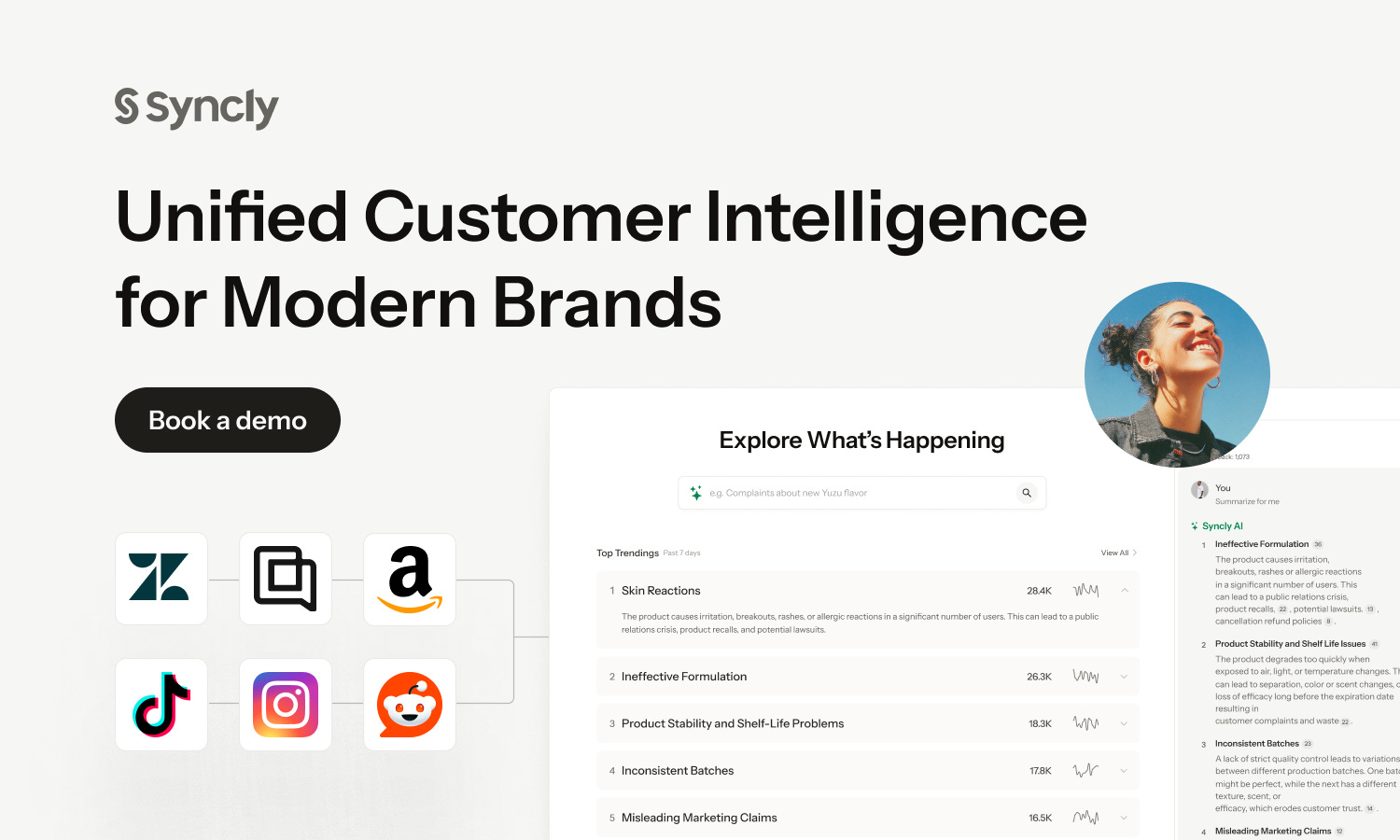
Syncly aggregates customer feedback from every corner (support tickets, product reviews, and social comments) to give you the single source of truth you have been missing.
Here is how it changes the workflow:
Discover Insights with AI: Simply ask questions like you would with ChatGPT, and get answers backed by direct customer quotes.
See Everything in One Place: Unify your internal support data with external social feedback (even video mentions!) for a truly comprehensive view of the customer journey.
Organize Effortlessly: Syncly uses AI to auto-tag and classify feedback into granular topics, so you know exactly what drives customer sentiment without the manual lift.
Act on What Matters: Get real-time alerts and automated dashboards to address critical issues before they churn customers.
You are in good company. From powerhouses like Fenty Beauty and Kosas to fast-growing disruptors like Neuro, Everyday Dose, and Hum Nutrition, brands are using Syncly to turn raw feedback into revenue.
Ready to scale your insights? Book a demo today and see exactly how Syncly can take your CX analytics to the next level.
The confidence problem
Most companies don’t struggle because they lack customer feedback. They struggle because they can’t get to what they already have quickly enough to feel confident making decisions.
When feedback is spread across tools and pulling it together takes real effort, decisions tend to drift toward whoever sounds most certain in the room. That certainty usually has little to do with having better information. It’s more about seniority, comfort, or simply being the person willing to speak first.
I’ve watched this show up in a few predictable ways that quietly cost more than people realize.
Product decisions get made by whoever tells the best story
A team is debating whether to build a feature. Someone says customers have been asking for it. Someone else says they’ve never heard it come up. Product says it’s doable but way too expensive. Marketing thinks it could help positioning, but no one is willing to say that with much confidence.
What nobody can answer is how often customers actually mention it. Or what language they use when they do. Or whether it shows up consistently across reviews, tickets, or social. The information exists somewhere. It’s just scattered enough that no one feels comfortable betting a decision on it.
So the conversation drifts. Eventually, the decision lands wherever the room settles that day. Months later, when the feature either works or doesn’t, it’s hard to explain why the call was made in the first place.
It wasn’t documented because it wasn’t grounded in anything concrete.
CX decisions optimize for what’s visible, not what’s costly
Support volume starts climbing, and the team feels underwater. Leadership approves more headcount to keep up.
What often goes unexamined is whether the issues driving ticket volume are the same ones driving churn. Some problems generate many tickets but barely affect retention. Other problems rarely surface in support at all. Customers hit them once, get frustrated, and leave without ever writing in.
When feedback isn’t organized in a way that connects issues to outcomes, teams naturally focus on what they can see most clearly. You end up staffing for noise rather than solving the problems that are actually costing you customers.
Marketing decisions lean on gut instead of customer language
A team is preparing to launch something new and debating how to talk about it. Is the value convenience, quality, or sustainability? Every option sounds plausible and has someone advocating for it.
The discussion stretches on, and eventually a decision gets made based on what feels familiar or what worked on a previous launch. At the same time, customers have already explained why they bought, how they describe the product, and what mattered to them. That language lives in reviews, comments, and forums. It just isn’t accessible while the decision is being made.
So the team makes a guess and hopes it lands. Sometimes it does. Sometimes it doesn’t. You only really find out once the campaign is already running.
What changes when feedback becomes usable
There’s been a lot of conversation recently about promptable analytics, where teams can ask questions directly and get answers without waiting on reports.
The real change here shows up in how decisions get validated.
When feedback is hard to access, strong opinions tend to dominate discussions. When feedback is easier to explore, assumptions get tested earlier and more often. Leadership can pressure-test ideas in the moment. CX can spot patterns before they escalate. Product and marketing can ground decisions in actual customer language rather than internal interpretation.
This only works if feedback lives in one place and is organized well enough to be useful. Adding a chat interface on top of a fragmented system doesn’t create clarity. It just makes the mess more visible, faster.
How teams stop guessing
One place to start is by looking backward. Pick a few recent decisions that actually mattered and ask whether the information was accessible at the time, or whether the decision relied mostly on confidence and instinct.
From there, consolidation matters more than you might think. Centralizing a single feedback source and making it easy for multiple teams to explore often reveals where the real blind spots are. The questions people ask once access improves are usually more telling than any dashboard.
It also helps to pay attention to how feedback changes over time rather than how much of it exists. Volume shows what’s happening. The pace at which sentiment shifts is often a better signal of what’s coming next.
This shift has less to do with adopting new tools and more to do with whether internal systems reflect what customers are actually saying. When feedback is accessible and trusted, decisions rely less on who sounded most confident and more on shared understanding. That difference compounds faster than most teams expect.
That’s it for this week!
Any topics you’d like to see me cover in the future?
Just shoot me a DM or an email!
Cheers,
Eli 💛
P.S. If you want to figure out how to get your brand to rank high in LLMs and show up in ChatGPT, Gemini, and more… check this out.
