


Hey team,
This newsletter comes to you from a quiet corner of the Moxy in Williamsburg after a hectic but really special week at Yotpo’s revenue kickoff. So excited about what the future holds.
3 coffees too many from Devoción, snacks from Mesiba, it's really all I need to feel something
This week’s topic is a hot one that no one is talking about.
Most brands spend way too much time on people who don’t care about them in the first place.
They (rightfully) pour a ton of energy into pushing order number one to order number two. They build increasingly complex programs to re-engage customers who bought once, maybe twice, and disappeared.
At the same time, they do so at the cost of customers who have bought 4+ times.
This week, I want to talk about how to spot when your best customers are starting to drift and what you can do to keep them close.
Let’s dive in.

This week’s newsletter is brought to you by DigitalGenius.

The problem with most AI Agents for CX is that they don’t actually solve customers’ real and pressing problems. They are OK at answering surface-level questions (when they’re not hallucinating or pulling from the wrong data source), but most can’t perform the actions that your customers actually need them to.
Take order queries, for example. It’s easy for AI Agents to share a tracking link – but that’s not enough for a customer whose order is delayed. To be relevant, the AI Agent needs to be able to retrieve order status, compare it against SLAs, and even authorize a replacement or refund – just as your human agents would.
This is the challenge that DigitalGenius is solving for brands like Caraway, Everlane, and On Running. Through deep integrations to ecommerce tech stacks, AI Agents can take real actions to fully resolve queries, not just deflect them.
Plus, with a unique hybrid approach that combines LLMs and workflows, answers are consistent, hallucinations are minimized, and conversations result in genuine resolutions. DigitalGenius has ready-made workflows built on 10+ years’ experience automating for ecommerce brands, so you can get started quickly and drive meaningful change for your business.
If you want your AI to actually resolve queries, and not just reply, then speak to DigitalGenius today.
Use Code Eli2026 and receive a $100 gift card when you book a demo.
What you’re missing about your best customers
There’s a difference between how casual customers leave and how your best customers leave, and most brands don’t notice it until it’s already too late.
Customers who buy once and disappear tend to make noise. They unsubscribe, stop opening emails, and generally announce they’re leaving. You can point to price, timing, or competition and feel like you understand what happened.
Your best customers behave differently. They stay subscribed, keep opening emails, and sometimes continue engaging with content. What changes is how often they buy, and that shift happens slowly enough that by the time it shows up in reports, they’ve already mentally moved on.
You see this most clearly when something small goes wrong, and the customer doesn’t bother telling you.
I saw this on X this week and wanted to share it as an example.
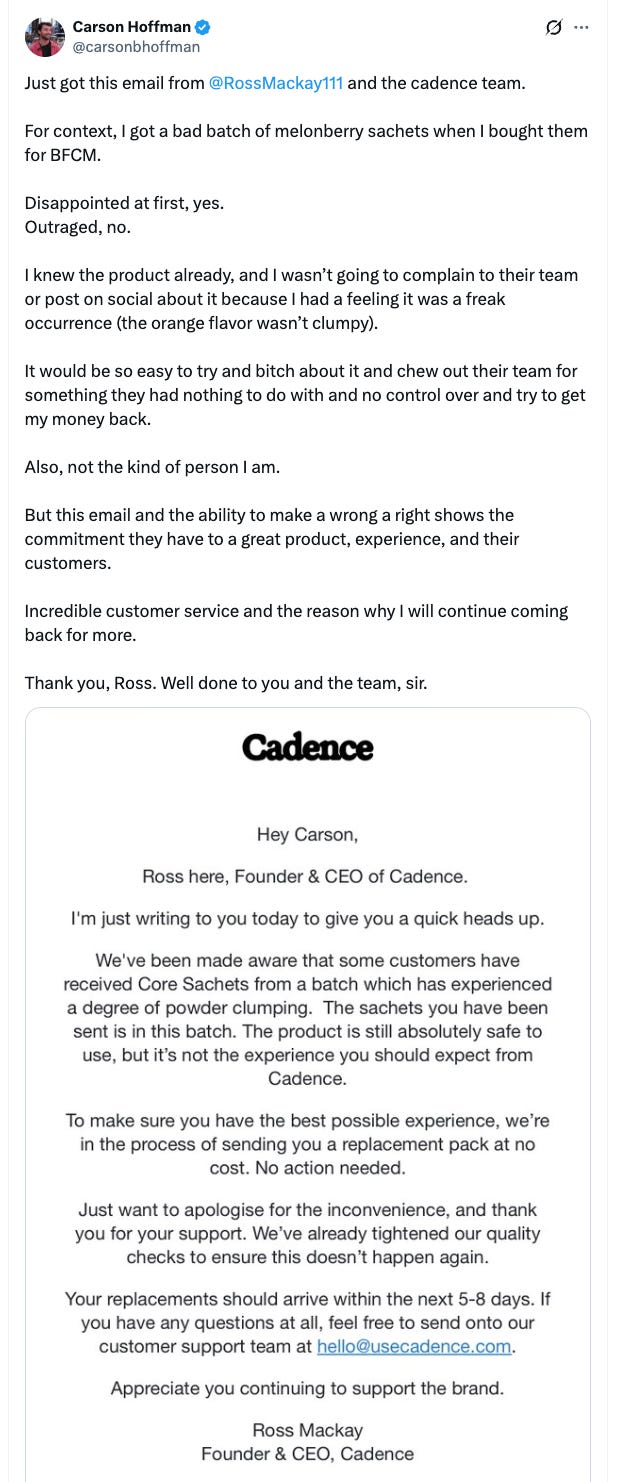
This is exactly the type of customer most brands never hear from when something breaks.
Ross didn’t wait for Carson to say anything. He emailed directly, explained what happened, took responsibility, refunded the order, and shipped replacements without Carson needing to ask. That single email turned what could have been a quiet fade-out into Carson posting publicly about why he plans to keep buying from Cadence.
The important part here is that Carson wasn’t showing the usual signals people look for when someone is about to leave. He wasn’t angry, posting on social, or opening support tickets. He was simply going to buy less over time and eventually stop without ever explaining why.
Brands miss this constantly because their systems are designed to respond to noise rather than silence. Companies build elaborate processes for angry first-time buyers who blast them publicly, while long-time customers quietly assume someone will notice and fix the issue.
When that doesn’t happen, they change their behavior and move on. Interpreting that silence as satisfaction is how those customers end up with a templated response or no response at all.
Carson was on track to buy less and eventually stop, and Cadence wouldn’t have known why until much later. Ross catching it early and dealing with it directly changed the outcome, not because the fix was complex, but because the brand noticed before being forced to.
Why power users drift away
Power users judge you by a different standard than new customers.
First-time buyers compare you to whatever brand they tried most recently.
Tenth-time buyers compare you to the version of your brand they fell in love with in the first place.
That’s a much harder bar, because standing still looks like moving backward.
Long-time customers notice things newer customers don’t. Packaging that feels cheaper than before. Support responses that take longer or feel more automated. Product launches that feel designed to hit quarterly targets rather than solve real problems. Emails that sound like they could have been sent to anyone.
They also notice when loyalty is treated like a line item. When someone who has placed a dozen orders receives the same emails and promotions as someone who bought once during a flash sale months ago, the message is clear.
Someone who’s been buying from you for three years doesn’t want to be treated the same as someone who found you last month. You don’t need an elaborate rewards program to acknowledge that. It shows up in faster responses, more relevant access, and communication that reflects an actual relationship with the brand.
When that recognition isn’t there, customers don’t usually get upset. They become indifferent, which is soooo much harder to reverse.
What actually works
You don’t need to rebuild your retention strategy from scratch to keep your best customers engaged. You need to consistently show that you’re still paying attention.
That shows up in small, meaningful improvements shipped regularly, even when they’re not flashy. It shows up in communication that sounds like a real person wrote it with context. It shows up in access or content that reflects an understanding of who these customers are and why they’ve stayed.
It also means having real conversations with them from time to time. Not pathetic surveys or mass NPS blasts, but actual back-and-forth discussions about what would make the brand feel better six months from now and then doing something with that feedback.
Most brands end up spending most of their time chasing people who never really cared much to begin with. Investing in the people who already care often feels less urgent because they aren’t complaining.
That priority order is usually backwards.
Your best customers are paying attention. They’re watching to see whether you’re still earning it.
That’s it for this week!
Any topics you’d like to see me cover in the future?
Just shoot me a DM or an email!
Cheers,
Eli 💛
P.S. If you want to figure out how to get your brand to rank high in LLMs and show up in ChatGPT, Gemini, and more… check this out.

That Cadence example is so good. One of the things I always tell brands is to keep an eye on your loyal / high AOV customers. If they show signs of churning, you should call them up.