


Hi Team,
What a week.
Over the weekend, I was driving with Noah to get some groceries before the storm, and five cops were chasing someone at 80mph. Guy slammed into us trying to escape. Side airbags deployed, my iPhone auto-called 911. The car called 911. The whole back wheel was ripped off, and the car was totaled.
Noah and I walked away seemingly without a scratch.
Modern cars are incredible.
And aside from the walloping we got from the snow on Sunday, we’re doing okay. Shaken but grateful.
Anyway. This week’s topic is fun, and one that a lot of you enjoyed last time I touched on it: returns.
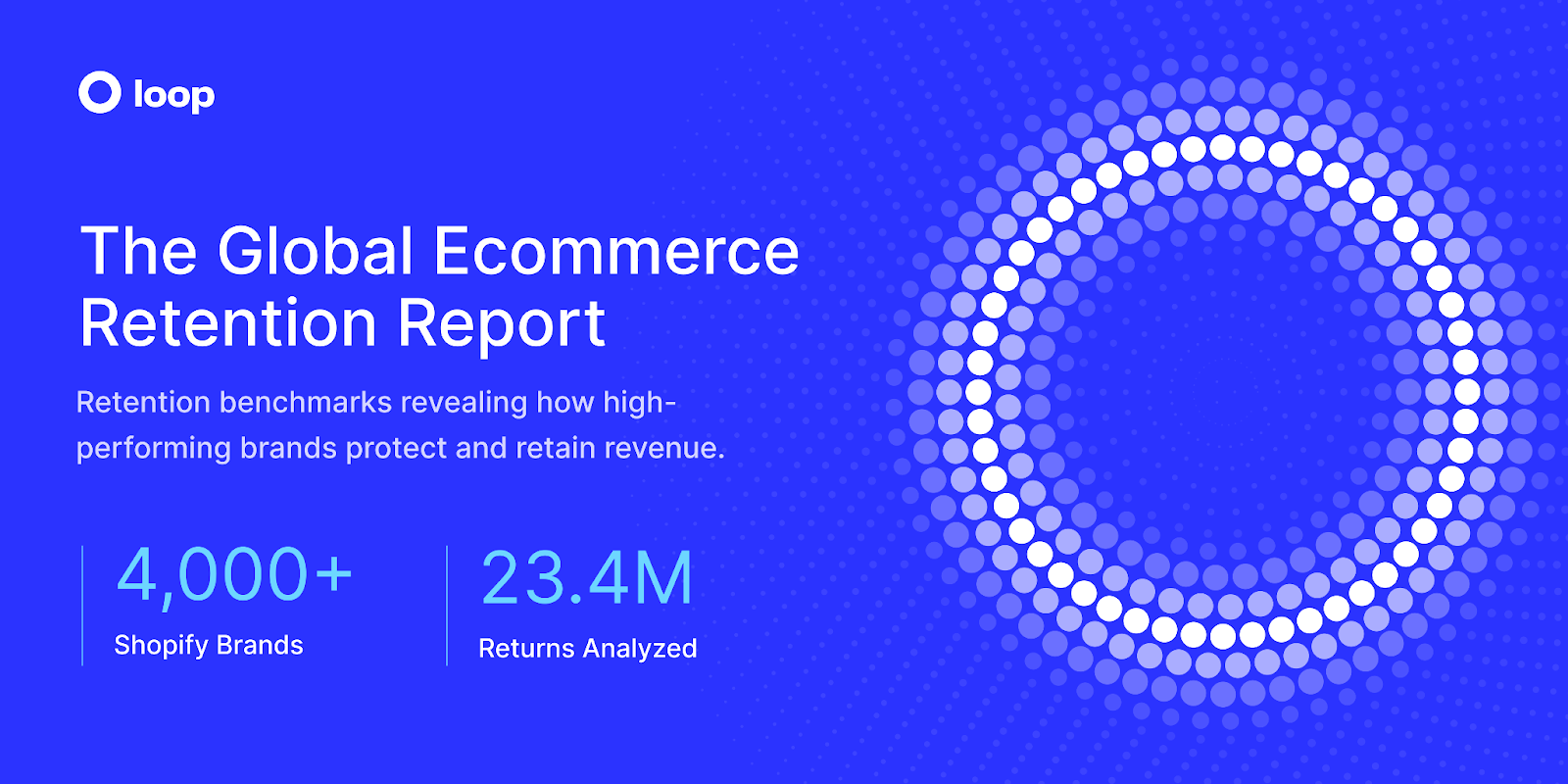
Specifically, practical tips to make more money and improve CX from returns. Loop surveyed tens of millions of returns across 4,000+ Shopify merchants and put together a benchmark report.
I pulled together some of the most fascinating and practical bits from it.
Let’s dive in.

This week’s newsie is brought to you by Loop!
Most brands settle for the average. Top brands don’t.
Too often, ecommerce benchmark reports tell you what the average brand is doing, then leave you guessing how to beat it.
Loop’s 2026 Global Ecommerce Retention Benchmarks Report was built to change that.
It analyzes tens of millions of post-purchase actions across 4,000+ global brands, giving you the context to better understand where your brand stands, which tradeoffs matter, and which levers actually drive retained revenue and loyalty.
What stood out:
Brands with flexible exchanges retain 42-58% more revenue than store credit-only setups.
Exchanges are now the norm. 73.6% of merchants offer them, and nearly half add incentives to shop immediately.
Return fees are increasingly selective. 65.2% of brands use targeted fees to protect margin while preserving loyalty.
Fraud is being addressed earlier. 11.4% of return value is flagged as high risk, pushing teams toward smarter controls instead of blanket restrictions.
This report shows the path to better retention, durable growth, and real-world playbooks from brands like LSKD and Piper & Scoot.
1. More options at returns = more money retained
Brands that offer three return outcomes (variant exchange, store credit, and refund) see 25% higher revenue retention than brands offering just one option. Same data shows 36% higher repeat purchase rate.
I’ve been saying this for years but seeing it across 23 million returns makes it harder to argue with.
Most brands default to refund-only because it feels simpler. Fewer decisions, fewer edge cases, less to manage. But that simplicity is pushing customers toward the exit at the exact moment they’re deciding whether to stay.
The customer is raising their hand saying something didn’t work. You can either solve the problem or hand them their money back. One of those keeps them around.
I returned something last month from a brand I’d bought from a few times. The portal gave me one option: refund. No exchange, no store credit, no “want to try a different size?” Just money back. So I took the money. And I probably won’t think about them again.
That’s what a refund-only policy actually costs you. Not just the transaction. The relationship.
2. Variant exchanges beat store credit
This surprised me a little. Store credit alone gets you about 19% revenue retention. Variant exchanges alone (letting someone swap sizes or colors) gets you 27%.
Store credit feels like a compromise. Variant exchange actually solves the problem.
Someone ordered the wrong size. They don’t want credit to use later. They want the shirt in medium instead of large. Let them swap it without thinking about it.
When you layer store credit and Shop Now (exchanging for anything in your catalog) on top of variant exchanges, retention climbs to 32%. But the foundation is the size swap. That’s your baseline win.
For apparel and footwear, this matters a lot. Fit is the whole game. Make it easy to fix. Footwear brands that offer exchanges see only 5% of returns flagged as high risk. Customer-friendly policies and low fraud can coexist when you’re solving the right problem.
Most brands I talk to have this backwards. They lead with store credit because it feels generous but noncommittal. But store credit is a consolation prize. Variant exchange is problem-solving. Customers feel the difference.
3. Free returns quietly became free exchanges
65% of merchants now charge return fees. Average is about $9.
But here’s what’s actually happening: they charge on refunds and waive fees on exchanges.
This is targeted friction. You’re not making returns hard. You’re making one outcome slightly more attractive than another. Customer still has a choice. You’re just nudging.
Some brands pair this with bonus credit on exchanges. Average across Loop’s network is around $11. Swimwear brands go higher, closer to $16. The math works because you’re paying $11 to keep a $50+ order from walking out the door.
I talked to a brand last year that was terrified to charge any fees at all. They thought customers would revolt. They tested fees on refunds only, kept exchanges free, added a small bonus for store credit. Revenue retention went up. Complaints didn’t move.
The fear of fees is usually bigger than the reality. Customers understand that shipping stuff back costs money. They don’t want to feel punished for ordering the wrong size, but they get that refunds have a cost. Charging on refunds while keeping exchanges free threads that needle.
4. Your VIPs should have a different return experience
VIP shoppers at brands using personalized return policies had a 55% repeat purchase rate. Brands with one-size-fits-all policies? 21%.
That gap is driven entirely by how you treat your best customers when something goes wrong.
Black Sheep, an Australian apparel brand in the report, runs three VIP tiers with different return benefits. General customers get $5 bonus credit on exchanges. VIPs get $15. First-time buyers get fees waived entirely to build trust early. Their revenue retention is 72%.
Piper & Scoot charges $10.95 on refunds but waives all fees for VIP customers. They also exclude refunds on heavily discounted orders to protect margin. Revenue retention is 63.5%.
If you’re running a loyalty program and your return experience doesn’t change based on tier, you’re leaving an obvious win on the table. Your VIPs have already proven they’ll come back. Make the return experience feel like it.
5. Fraud risk varies wildly by vertical
Electronics: 19% of return values flagged as high risk; average fraudulent return: $595.
Footwear: 5% flagged, $230 average.
Cosmetics: 8% flagged, $174 average.
Jewelry: 16% flagged, $462 average.
Your vertical determines your risk profile more than almost anything else. Blanket fraud rules applied across all product types are either too tight for low-risk stuff or too loose for high-risk categories.
One interesting pattern in the data: brands with the most generous return policies often have the lowest fraud rates. They’ve built systems to tell good customers from bad actors, so they can stay flexible with everyone else.
Restricting everyone because of a few bad actors is the lazy approach. Segmenting based on actual risk lets you be generous where it’s safe to be generous.
If you sell electronics and you’re not thinking hard about return fraud, you’re probably bleeding money you don’t even see. If you sell footwear and you’re running tight restrictions across the board, you might be creating friction that doesn’t need to exist.
What to do Monday
If you’re only offering refunds, add variant exchanges. Biggest lift for the least effort.
If you already offer exchanges, consider charging fees on refunds only while keeping exchanges free. Add a small bonus credit if margins allow.
If you have a loyalty program, make returns better for VIPs. Higher bonus credit, waived fees, faster processing.
If you haven’t reviewed fraud rates by product category recently, do it. The variance is probably bigger than you think.
Returns are a retention moment. Design them like one.

That’s it for this week!
Any topics you’d like to see me cover in the future?
Just shoot me a DM or an email!
Cheers,
Eli 💛
P.S. If you want to figure out how to get your brand to rank high in LLMs and show up in ChatGPT, Gemini, and more… check this out.
