


Hi Team!
If you know me, you know two things take up an unreasonable amount of space in my brain: customer experience and travel.
I’ve written 198 newsletters about the first one. Meanwhile, I’ve been to 40 countries, spent far too much of my life figuring out points, and somehow never really written about the second.
I want to change that.
Every once in a while, I’m going to write about a place we stayed, ate, wandered into, or couldn’t stop thinking about. There will probably be some CX in here because apparently I’m incapable of going on vacation without noticing this stuff, but these are travel stories first.
This is Trip Report #001: Modica.
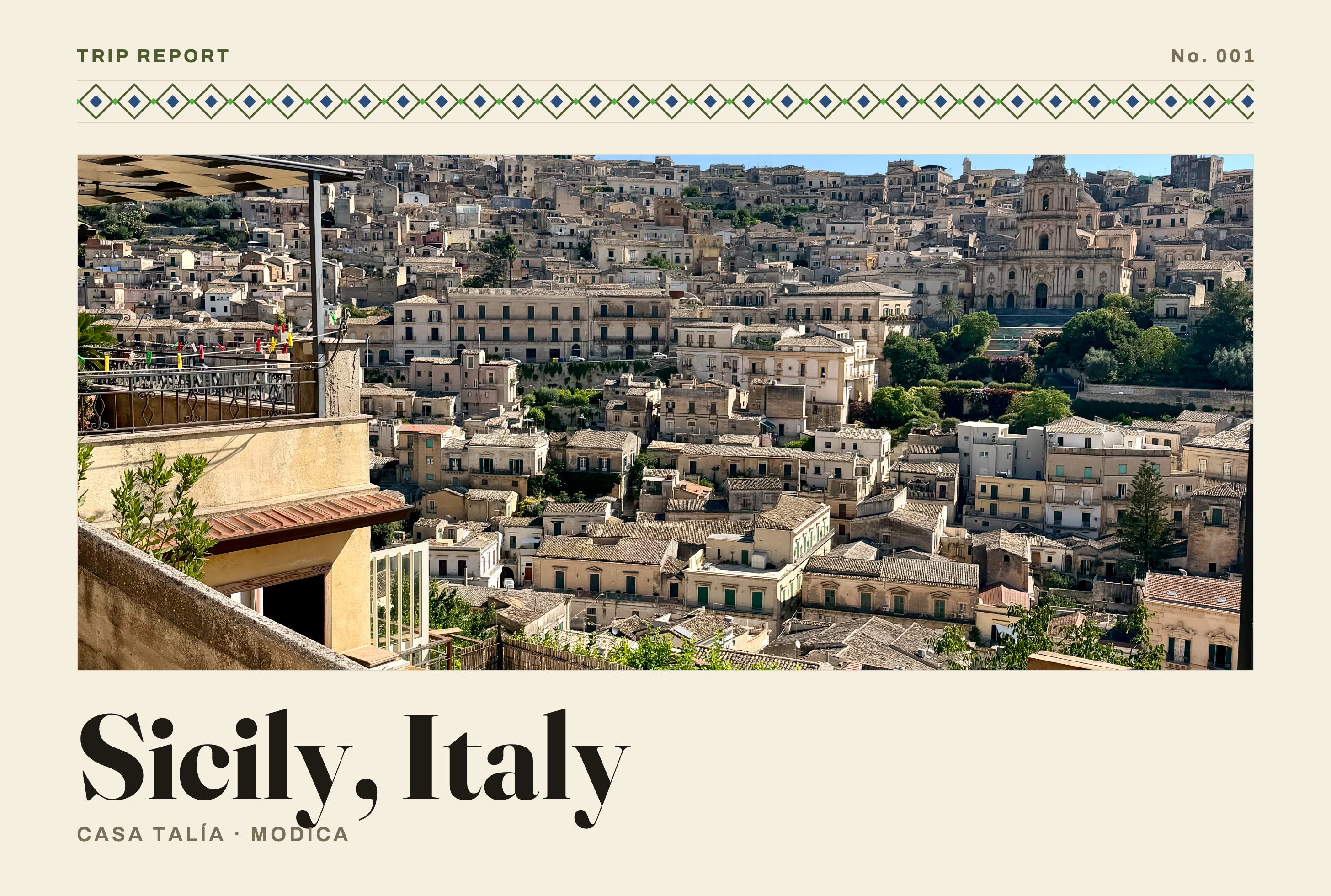
We got to Modica around 9 pm on Sunday night, which is late enough to arrive at a small hotel and immediately feel guilty about it.
A few hours earlier, Casa Talía had messaged us to say we were going to miss check-in. I apologized, assuming we were about to ruin the evening of some individual working reception.
When we finally pulled up, there was a man in his 60s standing down an alley waving us toward the parking spot.
Polo shirt, chinos, gray hair, small beard. Extremely Italian without making a production out of being extremely Italian.
His name was Marco.
He helped us with our bags and started walking us down the alley toward the hotel, except there wasn’t really a hotel.
There was no lobby or big entrance, and no reception desk with someone waiting to take a credit card for incidentals. Casa Talía is a collection of old little homes built into a hillside overlooking Modica, connected by narrow paths, gardens, stone walls, and lots and lots of stairs.
It reminded me a little of the hidden residential alleys in Jerusalem. You have the feeling that you’ve somehow wandered into somebody else’s neighborhood, except someone has left a very nice bed for you.
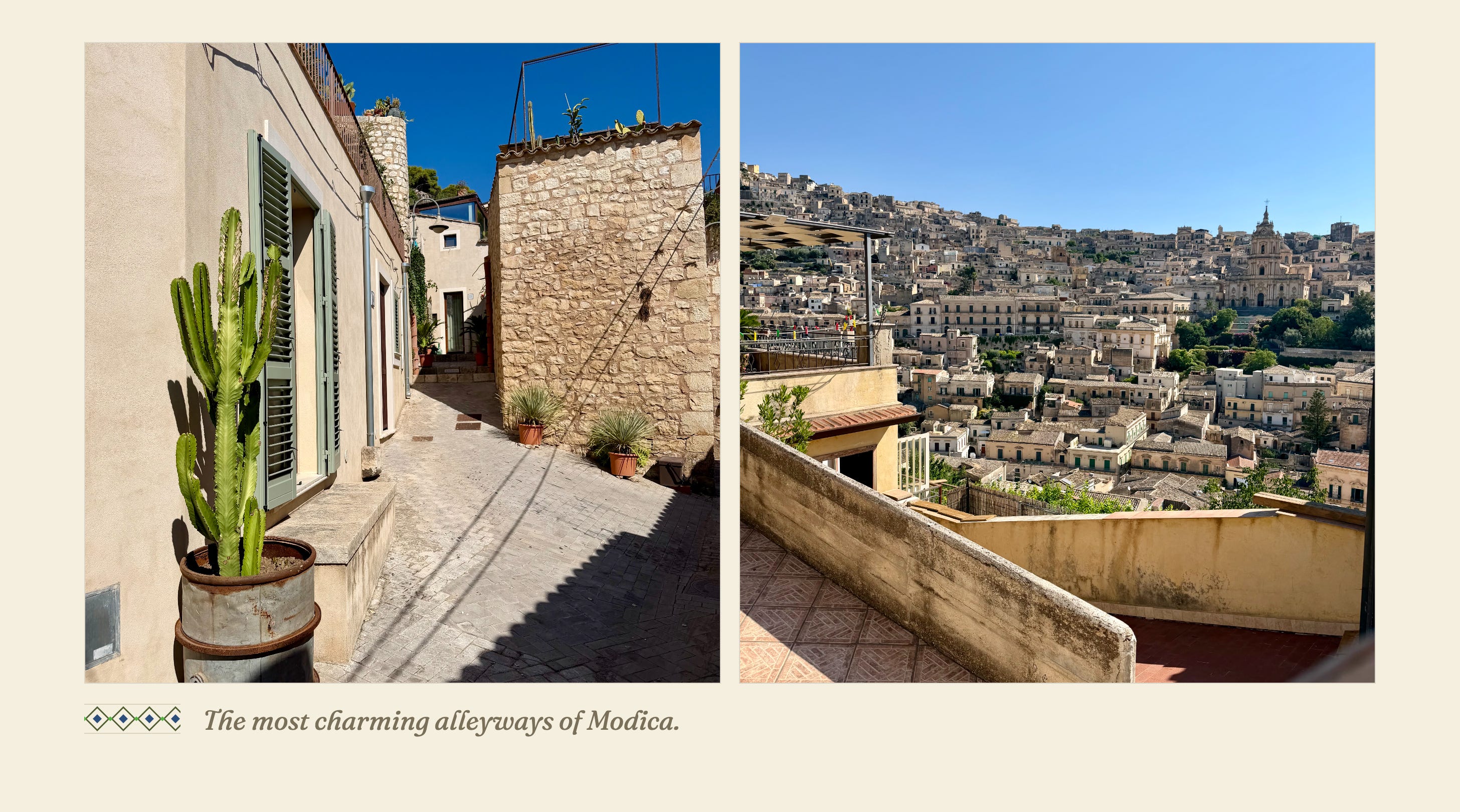
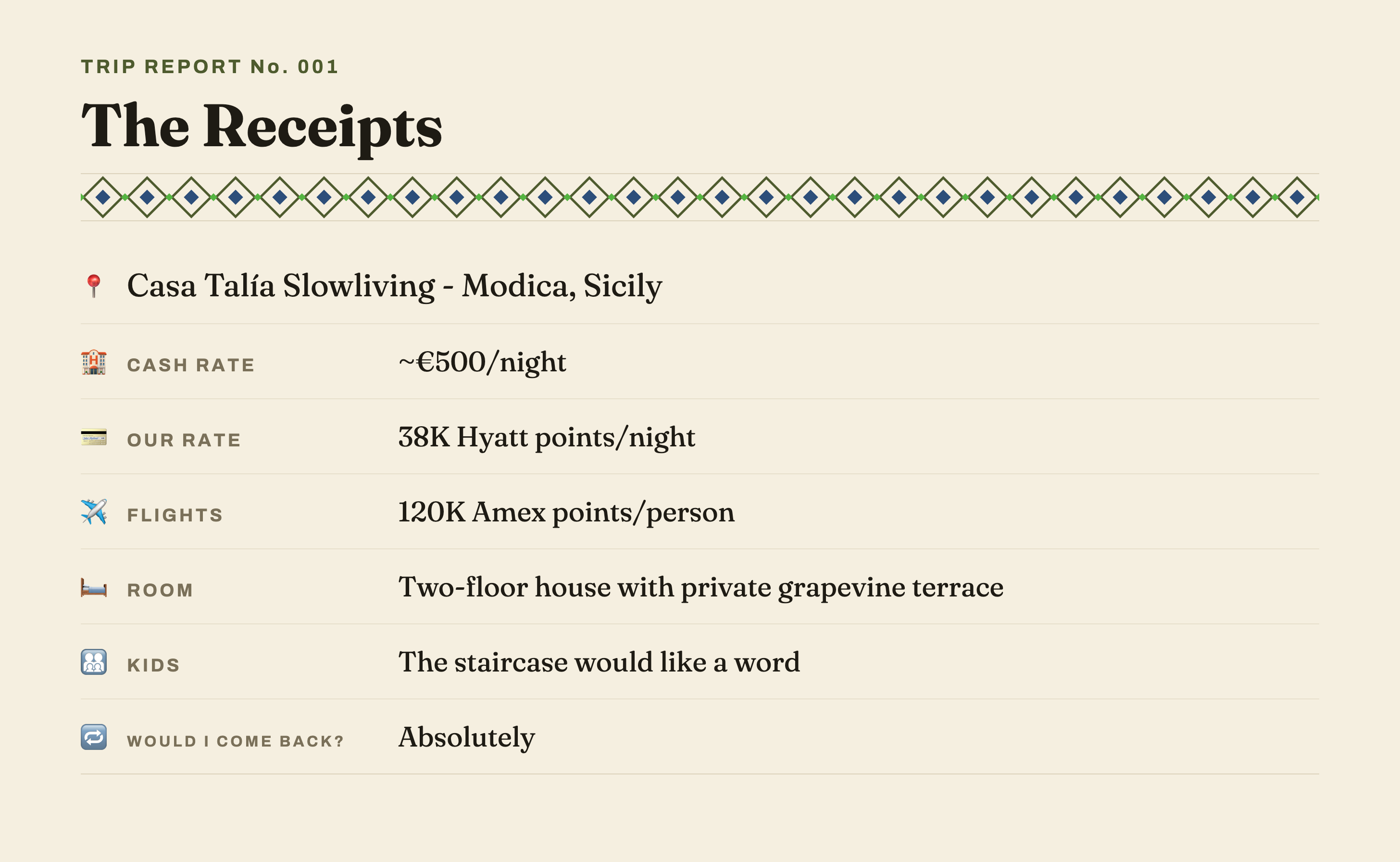
We followed Marco to the two-floor house we’d booked for three nights, which cost us 38,000 Hyatt points a night. Cash rates were around €500 a night, and I obviously chose the fake-money option because I have spent an embarrassing portion of my adult life making sure I never have to pay for a hotel.
The house was beautiful. White walls, cave-like ceilings, old stone, restored furniture and almost nothing unnecessary, with a little terrace outside covered in grapevines. You can sit at the table, reach above your head and pull off a bunch of grapes while looking across Modica, which is the sort of thing a hotel could spend an enormous amount of money trying to manufacture and still somehow f$ck up.
It also had a staircase apparently designed for a family with no children and no plans to ever encounter one.
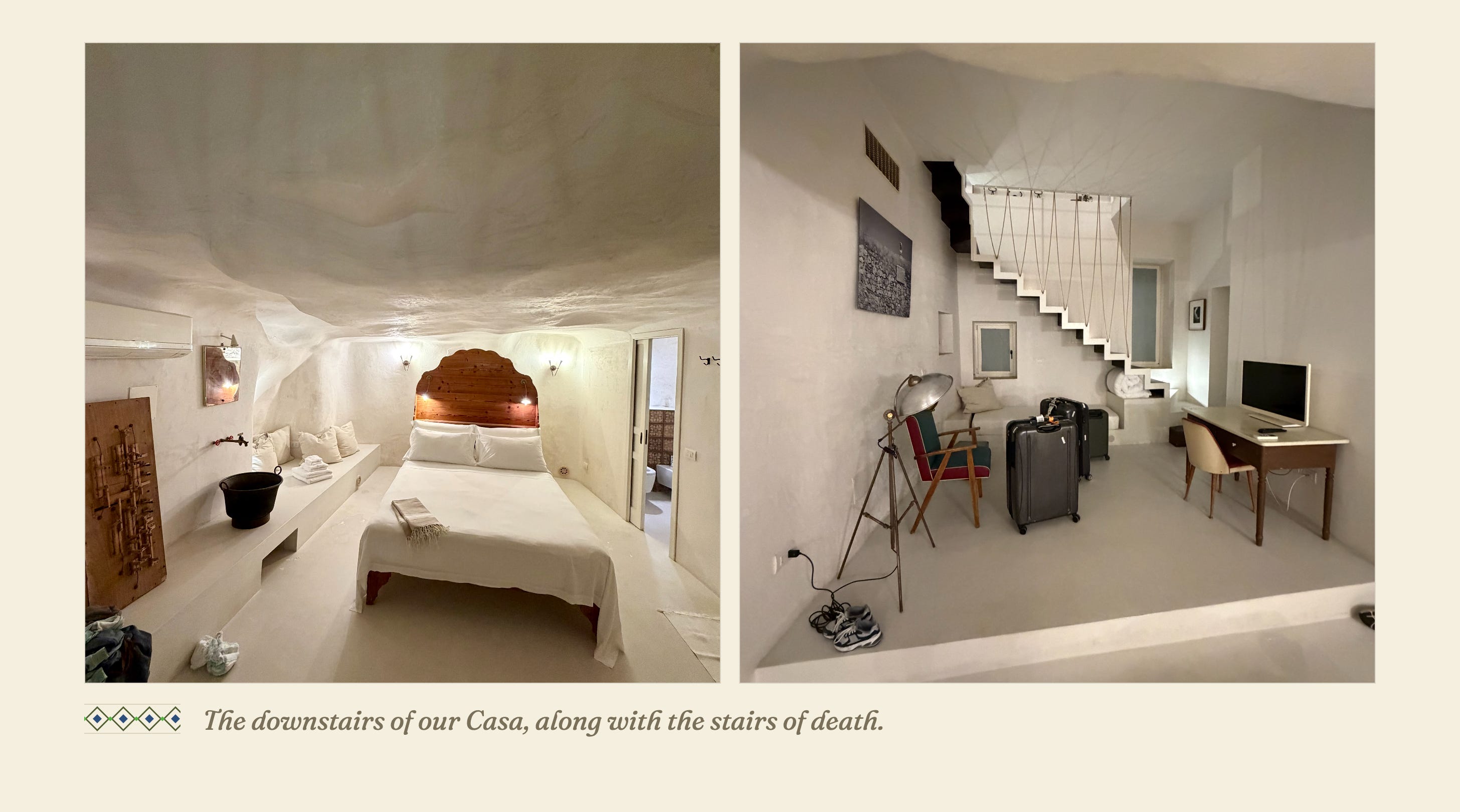
Instead of a banister, ropes hang from the ceiling every foot or so. Architecturally, very cool. As the father of two kids, I have spent considerably less time admiring the architecture.
This was our first introduction to what I ended up loving about Casa Talía. It is beautiful and high-end, but nobody seems particularly interested in sanding away every strange edge until it resembles every other expensive hotel in the world.
And then we found out the guy standing outside at 9 pm waving us into a parking spot was the owner.
Marco Giunta and his wife, Viviana Haddad, were architects living in Milan when they came to Sicily for a summer holiday in 2001. They ended up in Modica almost by accident and stayed for 15 days.
Then they bought a room.
They went back to Milan, returned to Modica, and bought another. Then another. Within eight months they had somehow acquired 12 little properties on the hillside, which is apparently what happens when two architects fall in love with a Sicilian town, and nobody stops them.
Every one of those rooms had originally been somebody’s home. Marco and Viviana restored them, kept the original exterior walls, and connected everything through the garden rather than turning the whole thing into one conventional hotel building.
Which explains why, more than twenty years later, you arrive at Casa Talía and spend the first few minutes trying to figure out where the hotel actually is.
It still feels more like someone’s slightly ridiculous collection of beautiful Sicilian homes than a hotel.
Marco also behaves more like the person whose house you’re staying in than the owner of a fancy boutique property.
He’ll tell you where to eat and, just as confidently, where he wouldn’t bother. He says buongiorno every time he sees you. If you need something, somebody appears. He tells the story of how he ended up here with the enthusiasm of someone who still can’t quite believe this became his life.
And he’s there in the morning.
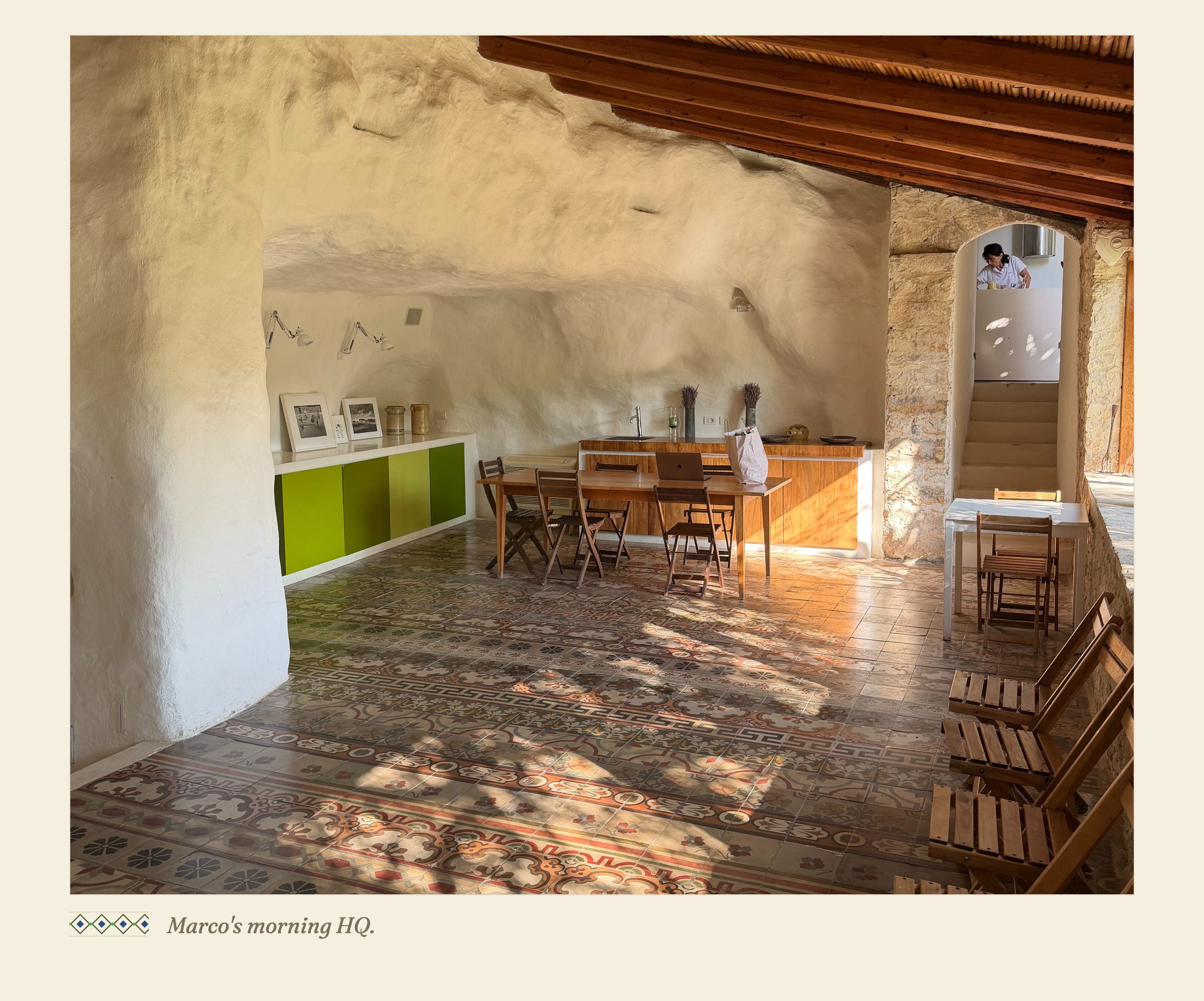
Breakfast happens outside under olive trees overlooking the old city of Modica. The view is stupid.
The churches and old stone buildings climb up the opposite hillside, framed by branches from the trees above you. Breakfast comes out slowly: bread, yogurt, juice, tomatoes, grilled zucchini, cheese, figs, fruit, jams. Much of it is grown locally or comes from whatever is actually in season nearby.
There isn’t a buffet with 11 kinds of cereal sitting under fluorescent lights. You sit down and eat what Sicily has that morning.
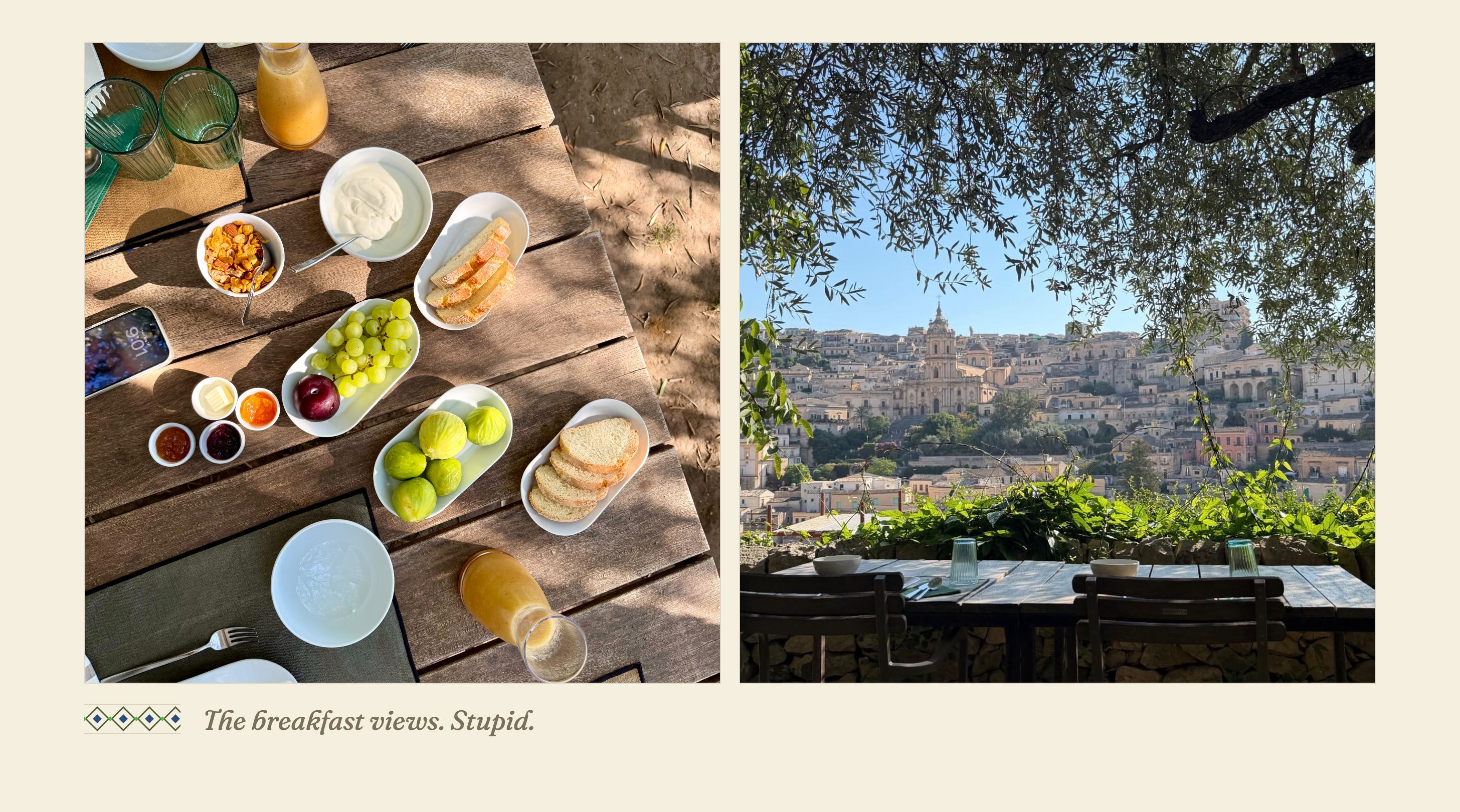
Marco hangs around nearby, talking to guests, checking in on people, and generally holding court.
Then there’s Riz.
I’m not entirely sure what Riz’s official job title is, and after a few days here I’m not convinced Casa Talía believes very strongly in official job titles. He checked us in, serves breakfast, handles the concierge stuff, fixes whatever breaks, and somehow finds time to play with our kids.
He also has an unnerving ability to appear.
At one point, our key wouldn’t open the door to the pool. I sent Riz a WhatsApp, looked back at the door, and maybe 15 seconds later he was standing behind me smiling with a new key.
I have no idea where he came from.
It’s like having a concierge who can apparate, except Hogwarts apparently has worse response times.
That’s basically how it works with Riz. You text him and within 30 seconds there’s a decent chance he’s standing in front of you, smiling, already fixing whatever you were about to ask him to fix.
He is a f$cking legend.
One morning while we were eating breakfast, I noticed that the housekeeping room overlooks the patio.
This means the staff knows when you’ve left your room because they can literally see you sitting under an olive tree eating breakfast. By the time you finish, they’ve usually been upstairs and cleaned it.
I’ve spent a decade around companies buying increasingly complicated technology to figure out where a customer is and what they might need next.
Casa Talía has a window.
There are little things like this everywhere once you start paying attention.
Our terrace has actual grapes hanging over the table. There are fig trees around the property. Old stone paths run between the rooms because the rooms were once separate homes. There are corners of the property where it’s hard to tell where Casa Talía ends and Modica begins.
Very little feels designed around what a hotel is supposed to have. It feels like they started with what was already here and figured out how to let people stay in it.
That applies to the people too.
I’ve stayed at hotels that know an absurd amount about me. They know what floor I prefer, when I last stayed, what status I have, probably what I ordered from room service in 2022. Some of them are incredible. Others manage to know everything about you while making you feel like room 416.
Casa Talía knew almost nothing about us when we arrived. Marco knew we were late, so he waited outside. Riz got to know the kids. Someone saw us eating breakfast, so they cleaned the room.
You start to wonder whether we occasionally make this stuff more complicated than it needs to be.
The WiFi password at Casa Talía is slowliving.
Of course it is.
I initially assumed this was a cute hotel thing, but Marco has been talking about slow living for years. He once described it as forgetting your phone, drinking a glass of wine, looking across at the Baroque buildings and sitting under the olive tree with a book.
There is one problem with this philosophy.
Marco also says he works 24 hours a day.
He said that years ago when asked what running Casa Talía had done to his life. In the same answer, he said his life was much better than it had been before. He gets to live near the sea, see blue sky and sun every day, and spend his time around people who are generally pretty happy to be there.
I love that answer because it makes slowliving slightly harder to explain.
Marco didn’t escape work. If anything, he seems to have created considerably more of it. He just built a life around work he actually wanted to be doing, in a place he didn’t want to leave.
Maybe that’s why nothing here feels particularly slow when you actually need something. When our fuse went out, Riz was there almost immediately. Breakfast appears, rooms get cleaned, bags get carried, kids get entertained.
The slowness seems to be somewhere else.
Most of my professional life has been spent around companies trying to make experiences scalable. You document things, build processes, create roles with clear responsibilities, automate the repetitive parts, and try to make sure the customer gets roughly the same experience regardless of who happens to be working that day.
There are very good reasons for doing all of that. It also removes some of what makes places like Casa Talía special.
If you asked me what the best part of the hotel is, I wouldn’t say the room. The room is beautiful, but I’ve stayed in nicer rooms. I wouldn’t say the pool either. It’s tiny. I wouldn’t even say the view, although the view at breakfast makes it very easy to lose an hour doing absolutely nothing.
I’d probably say Marco.
Which is a terrible answer if your job is figuring out how to scale Casa Talía to 200 locations.
How do you scale the owner standing in an alley at 9pm because a family he has never met is arriving late? How do you operationalize a sixty-something Italian architect telling you where he thinks you should eat dinner?
You could put his recommendations into an app. You could write down exactly what he says when guests arrive. You could create a breakfast SOP, photograph the way the tables are set and train everyone to say buongiorno with precisely the right amount of enthusiasm.
I’m sure you could recreate a lot of it.
I’m not sure you’d end up with Casa Talía.
We spend so much time in business trying to remove dependency on individual people. I understand why. If the company only works because one person is there every day, eventually you have a problem.
Travel has made me wonder whether we occasionally take that idea too far.
Some of the places I remember most are memorable precisely because of one particular person. The restaurant where the owner decides what you should order. The tiny store where someone spends 45 minutes helping you find something that costs $20. The hotel where the guy who owns it is standing outside waiting because he knows you’re arriving late.
Those businesses may be less scalable. They may also be considerably more difficult to forget.
Casa Talía is interesting because Marco isn’t the only one.
Riz isn’t doing an impression of him. He has his own personality and his own relationship with the guests. His job seems to be whatever needs doing at that particular moment.
There’s no obvious attempt to make every person sound or behave exactly the same. They just seem to care about the same place.
Casa Talía doesn’t feel luxurious in the traditional sense. Nobody is polishing marble in the lobby because there is no lobby. The pool is tiny. The stairs remain an ongoing threat to the Weiss bloodline.
But sitting under an olive tree eating tomatoes and cheese while Modica wakes up across the valley, you don’t find yourself wondering what’s missing.
Marco and Viviana started buying these little houses twenty-five years ago. Somehow, after all that time, it still feels like the people here are paying attention.
Maybe that’s what slowliving actually means.
Or maybe I’ve spent too many years working in CX and should be capable of eating a fig without turning it into a business philosophy.
Either way, I’m listening to Marco.

More of these please
Loved this so much...thanks a lot...