
Hi Team!
Welcome back to school. If I ever get to teach a fall class at a university, this is the syllabus. Consider it my TED talk, minus the headset mic and the big red circle on the floor.
Every subscription brand I talk to asks the same question: how do we 10x retention? Nobody likes the real answer, because the real answer is boring. It’s the basics. And in an age of AI, the basics are going to matter more than anything.
Let’s get into it.

This week’s newsie is brought to you by my friends at Horatio!
Picture this: it’s peak season, tickets are flooding in, and your outsourced team is handling refunds, subscription changes, and card updates as fast as they can.
Now picture one of those agents working from a laptop with no screen lock, on a shared login, with no record of what they clicked.
It’s an easy gap to miss. When you’re choosing a partner, cost, speed, and CSAT understandably come first, and workstation setup rarely makes it onto the list.
But when the team handles billing, those details matter, and they usually only come to light during an audit or after a customer complaint.
And since it’s your helpdesk and your customers, that’s where the impact is felt most.
The good news is that you don’t need a compliance background to catch this stuff. You mostly need a list of what to ask, so we wrote one.
The SOC 2 & GDPR Checklist for Outsourced Billing Support covers workstation setup, access controls, and the compliance basics. You can use it to vet a new partner or to check the one you already work with.
If you’re bringing on seasonal agents for BFCM, it’s worth going through before they get access.
The 10x question
Nobody asks how to make the product show up on time. Nobody asks whether the shipping estimate on the site is honest. Those questions aren’t sexy.
Sorry, Chad, but retention is mostly boring. The brands that keep customers for years aren’t running super secret black-hat plays. They made a good product, priced it fairly, shipped it when they said they would, and taught people how to use it. Then they did it again the next month.
In an age of AI, the basics matter more, not less. AI will write your emails, answer the bulk of your tickets, and build your segments, and every competitor gets the same toys.
What it can’t do (yet) is roast good coffee, charge a fair price for it, and get it to the door on the day you promised. People just want something reliable. They always have.
The coffee test
Think about your own subscriptions. I get coffee on subscription because I drink coffee every day. If the coffee is good, the price is right, and it shows up when expected, canceling rarely crosses my mind. Which is precisely why I subscribed in the first place. I’d have to go out of my way to leave, and I’m lazy, so I stay.
That’s the whole game. Expectation on one side, reality on the other. When reality matches expectation, retention takes care of itself. When it doesn’t, no winback flow ever written will save you.
The bar is rarely delight; it’s doing what you said you’d do, every month, without making me think about it. The moment I have to think about my subscription is the moment I start doing math on it.
Why subscribers actually cancel
When someone cancels, it’s almost always one of four recurring problems I see behind subscription churn.
There was never a real need. Your 40% off first-order promo + 6 free gifts got them in the door, but they were never going to need you every month. That’s an acquisition problem…
They don’t understand the efficacy of the product. They bought the supplement, the serum, the software, and nobody taught them how to use it, what results to expect, or when to expect them. Confused people cancel.
It wasn’t as expected. The box was late, the flavor was off, the size ran weird. Reality missed the promise.
It wasn’t worth the perceived dollar value. Notice the word perceived. The product can be objectively great and still lose here if the customer never understood what they were paying for.
The first one is an acquisition problem. The other three are basics you can fix before the customer ever complains, and not one of the four gets fixed by a bigger discount.
Fill the valleys first
Brands love building peaks. The big billboard launch, the crazy promo, the gift with purchase, the outlandish surprise and delight program. Peaks are fun to work on, and they screenshot well for the board deck.
Valleys are where retention actually lives. The shipment that went out two days late. The billing email that confused someone into a chargeback. The support reply that answered a question nobody asked.
You can run the craziest promotion in your category and get someone in the door exactly once. If the basics are broken, that’s all you get: one order, one disappointment, one cancellation. A customer who rarely has a bad month has little reason to leave.
The law is catching up
On October 1, New York City became the first city in the country where canceling a subscription has to be as easy as signing up for one, by law.
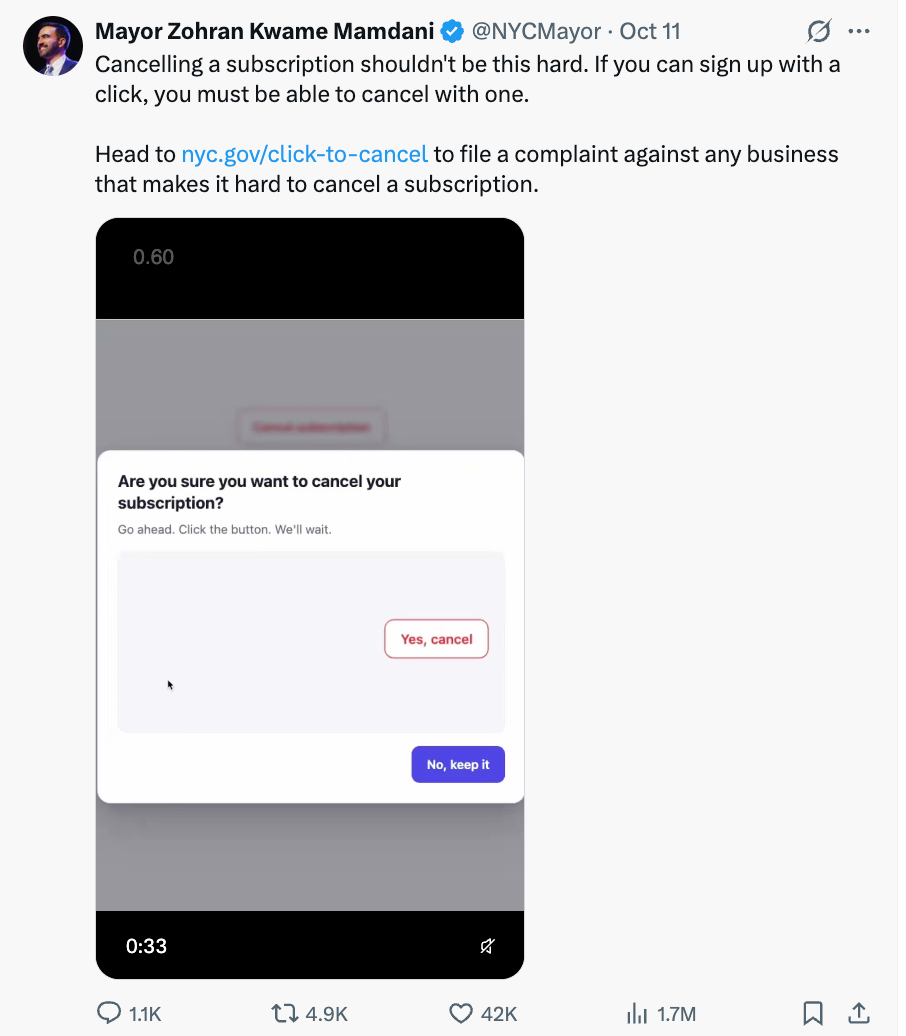
If a company can take your money with one click, you can leave with one click. Signed up online, you cancel online.
No more sitting on hold for 45 minutes to quit a gym you last visited in January. Fines start at $525 per violation, and the city even launched a complaint portal for it. The projected savings are up to $162.5 million a year, which is a polite way of saying that’s how much the friction was worth.
The FTC tried to do this nationally, and a federal court killed the rule last year, days before it was supposed to take effect. So now it’s happening state by state instead.
More than half the states already have auto-renewal laws; New York State passed its own version last spring, California’s has been in force since last summer, and I’d bet most of the rest follow within a few years.
If your retention plan depends on it being annoying to leave, you are on a clock. TIK TOK.
Your pre-BFCM audit
BFCM is around the corner, which makes this the right week to audit the boring stuff. Consider it homework. It will be on the exam, and the exam is Q4.
Subscription flows. Can a customer skip, swap, or pause without emailing support? If not, you’re generating tickets and churn on purpose. Smart subscription flows let people adjust instead of cancel.
Nurture flows. Look at what goes out after the first order. If the sequence is three discount emails and a review request, that’s not a nurture flow. Teach people how to get value out of the thing they just bought.
Education. Do customers know how to use the product, when to expect results, and what working looks like? Churn reason number two is entirely on you.
Shipping promise. Is your estimate honest, and does it hold? Underpromise by a day and overdeliver. Nobody has ever canceled because a box showed up early.
Consumption and cadence. Look at when customers actually need another shipment versus when you’re sending one. Someone sitting on three unopened bags of coffee probably isn’t excited about a fourth showing up tomorrow. Give them an easy way to adjust frequency before the next charge becomes the reason they cancel.
None of this is a rebrand or a replatform. It’s a week of honest auditing and a few fixes, done before the flood.
Retention was never about the cleverest play. It’s the basics, done well, on repeat, while everyone else hunts for a 10x button.
Class dismissed. Don’t forget the homework.

That’s it for this week!
Any topics you’d like to see me cover in the future?
Just shoot me a DM or an email!
Cheers,
Eli 💛