


Hi Team,
We’re practically in October… so close to BFCM I can smell it.
I read a post this week from Sean Frank, Ridge’s CEO, that stuck with me. He said revenue would fall 70% if he took his foot off the gas. That’s a hell of a dependency to have.
His point is that selling a wallet today doesn’t automatically help sell the next one. You still have to find and convince another customer, without the network effects you get in some other businesses.
I wouldn’t pretend a better support team could make that dependency disappear. But it did make me wonder how much we spend acquiring customers we then leave to figure out the product themselves. By the time they need something else, we’re back in the auction trying to convince them again.
With BFCM coming, I think that deserves a little attention.
Let’s get into it.

This week’s newsie is brought to you by my friends at Horatio!
Seasonal hiring is a lot more expensive than it looks on paper.
If you’ve ever built out a temporary team for peak season, you know the drill: recruiting on a tight timeline, background checks, training people up fast, and then someone on your team taking on the extra work of managing it all.
And just as everyone is fully ready? Peak season’s over, the team’s gone, and you’re starting from scratch next year.
Once you add up the real cost per agent (recruiting, training, management, churn, and all the little hidden costs) that “budget-friendly” seasonal team isn’t looking so budget-friendly anymore.
Wondering how your setup stacks up? See exactly where you stand with Horatio’s side-by-side comparison chart. And if you’re curious what a hybrid model could look like for your specific order volume, their team’s happy to help you map it out.
The first order should help earn the next one
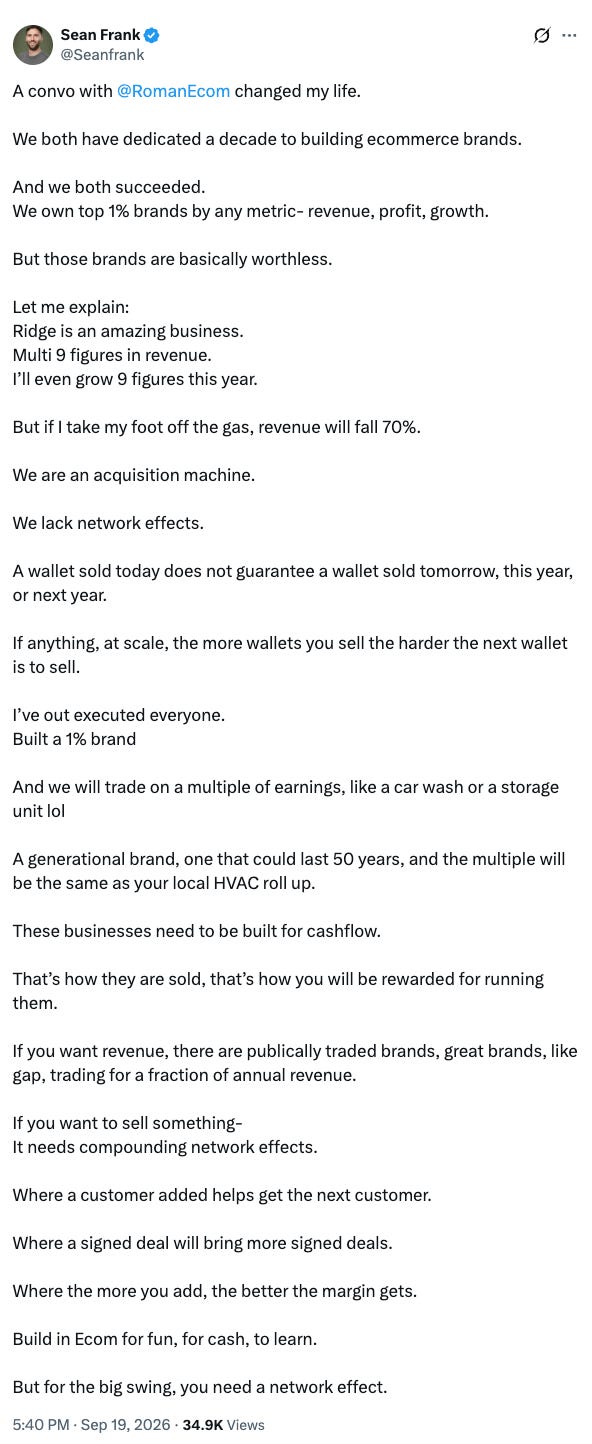
Ridge has built a huge business by getting very good at finding the next customer. Sean’s point is that the work keeps coming: selling a wallet today doesn’t create a network effect that brings tomorrow’s buyer along.
A wallet that lasts for years also shouldn’t need replacing every few months. The next sale might be a gift, another product, or a friend buying because someone they trust recommended it.
We spend a lot of money getting someone to believe the product page. Once they buy, we seem considerably less interested in whether they still believe it.
If you want the wallet customer to consider your other categories, the first purchase needs to give them a reason to trust you with another one. Knowing how to use it, getting a question answered, and finding out whether the guarantee is any use when something breaks all contribute to that decision.
Those moments can also give someone a reason to look elsewhere, without ever opening a support ticket.
The questions your support team never hears
Imagine a customer buying a $160 pair of boots. The ad says they get better the longer you wear them. The product page says they’re built to be resoled instead of replaced.
They arrive in a plastic bag inside a plain box, with no information about break-in or care. He wears them Monday, and by Wednesday they’re hurting his feet. He doesn’t know whether they need time, whether he bought the wrong size, or whether these particular boots just aren’t for him.
So Thursday night he types “do leather boots hurt this much at first” into his phone and spends twenty minutes on a subreddit where four strangers explain his own purchase to him. Two of them recommend a different brand, which is a generous little acquisition service for your competitor.
He had a question about your product, and somebody else was there to answer it.
Later, when the heels wear down, he remembers the resole promise. The link is in the footer and opens a form asking for proof of purchase he can’t find. Shipping is on him, and the turnaround is six weeks.
Six weeks without the boots he wears every day is a fairly compelling reason to buy another pair. He closes the tab and keeps wearing them until he’s ready to replace them.
When that day comes, he opens three tabs. One of them is the brand from that thread.
Nobody escalated anything, nobody asked for a refund, and your CSAT for the quarter is lovely. He never created a ticket, so your support report has nothing to say about any of this. You paid to acquire him, then left him to work out the ownership part with strangers.
A care guide could have explained break-in and when to ask for help with the fit. An order lookup could have spared him the receipt hunt. And if resoling is a reason to buy the boots, I’d want the cost and turnaround visible before checkout, with a process worth using when the time comes.
Nobody puts a car fire in the annual plan
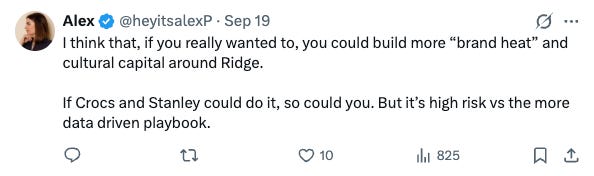
The first purchase can also give people something worth sharing. In her reply to Sean, Alex points to Crocs and Stanley as examples of the brand heat Ridge could try to build, while acknowledging how much riskier that is than a familiar, data-driven acquisition playbook.
You probably remember the Stanley video: a woman’s car burns, her Quencher is still in the cupholder, and there’s still ice inside it. The president responds on TikTok and offers to replace her car.
The product got an absurdly good demonstration of its durability, entirely by accident. Then the company gave people a second reason to talk about it. Replacing the cup would have been understandable. Offering to replace the car made the response part of the story.
It’s a maddening example if you’re trying to plan for it. You can put a media budget in a spreadsheet and argue about the assumptions. Nobody can promise you a Stanley moment in next year’s plan.
I would, however, want to know whether my company could respond to one before the internet moved on. If replacing a damaged order requires three approvals, I have some concerns about our readiness to buy someone a car.
Someone has to notice, someone has to be able to make a call, and the response has to arrive while people still care. Oh, and it doesn’t always need to be a goddamn car. There are much quicker, cheaper ways to do this.
Most brands will never get a Stanley moment. They will get a customer trying to use a repair promise, a gift that arrives damaged, or a question the product page never answered. Those are less spectacular opportunities to give someone a story worth repeating, and they turn up without requiring anyone’s car to catch fire.
I’d happily keep funding the acquisition machine while working on this. I’d also want someone responsible for making sure the experience we’re selling holds up after delivery. Otherwise we’re paying to bring more people into the same disappointing process and wondering why nobody recommends us.
What I’d actually fix before BFCM
I’d work through four things before sending another wave of first-time customers into the same experience:
Buy and return your own product. Use a new email, pay normally, and give nobody an internal heads-up. See what the customer has to figure out without the benefit of working at your company.
Find three unanswered first-month questions. Ask your support team, read reviews, then search the questions yourself. If Reddit explains how to use your product better than you do, you have some fairly obvious homework.
Compare early reviews with later ones. Someone who opened the box yesterday can tell you about delivery and first impressions. Someone who’s used the product for months can tell you what held up, what became annoying, and what they wish they’d known.
Try using your guarantee. Follow the actual steps. Check the cost, turnaround, and information required. If the customer has to find a receipt your team could look up in thirty seconds, fix that before writing another paragraph about how much you care.
Then I’d check what the rep can do when one of these problems reaches them. If the customer clearly qualifies for a repair, can the rep arrange it? If the case needs judgment, is there someone available to make the call? A good policy is considerably less useful when everyone is waiting for the one person who’s allowed to apply it.
Before BFCM, I’d put the product page next to the experience of actually owning the thing and work through every place they disagree, from the care instructions and repair process to the person who can make a decision when something goes wrong.
You’ve already paid to persuade this customer once. When someone asks them where to buy boots, I’d like them to recommend the pair they own, with a better reason than “the ads were good.”

That’s it for this week!
Any topics you’d like to see me cover in the future?
Just shoot me a DM or an email!
Cheers,
Eli 💛