


Hi team,
Happy 2026. We’re back.
If you’ve been online over the last few weeks, you’ve seen the same things I have. Q4 was either described as incredible, disastrous, or the moment the recession everyone has been predicting since 2022 finally decided to arrive.
From where I sit, it looked maybe a tiny bit less dramatic than that?
Most brands I spoke with had a softer first half of 2025. Spending faced more scrutiny, growth felt harder to manufacture, and efficiency started to matter again. As the year went on, a surprising number of those brands finished stronger than expected. In nearly every case, it came down to the basics holding up when things felt tighter.
Which brings us back to retention.
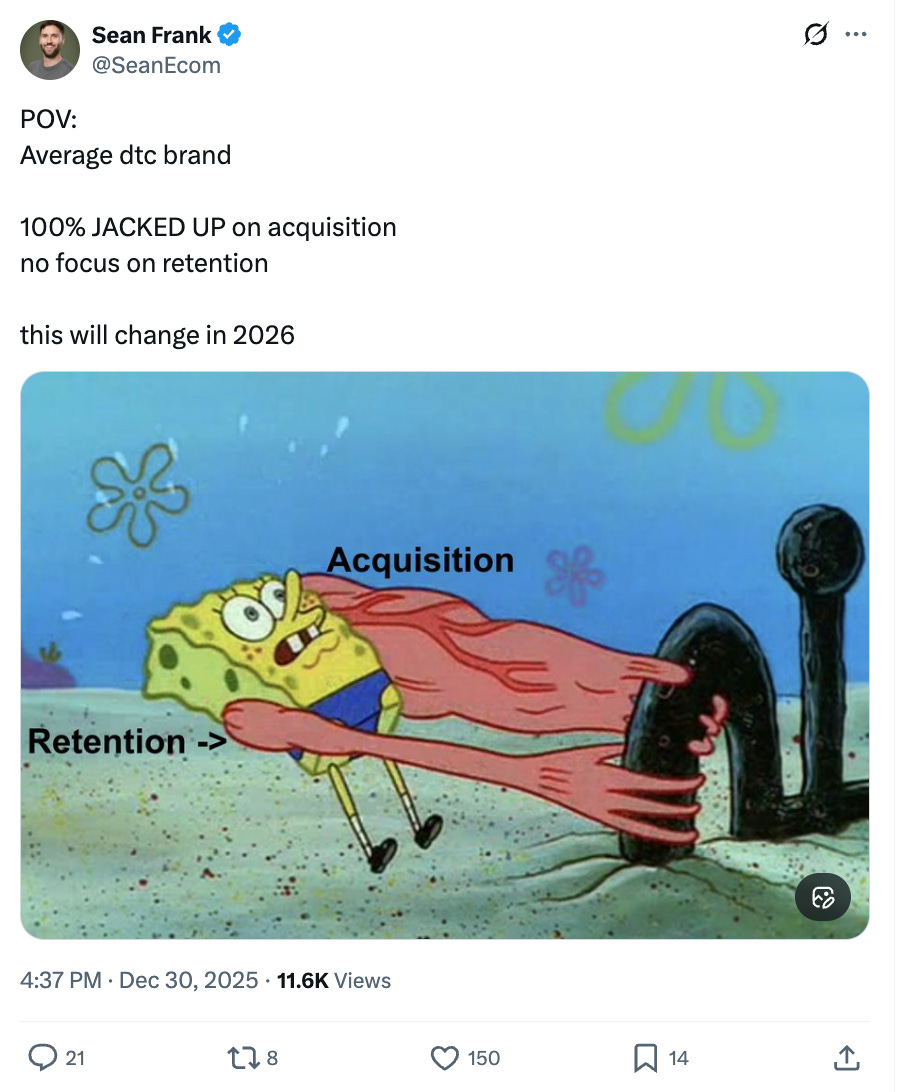
I see this cycle every year. Acquisition gets harder. Retention becomes the answer. Next year is when everyone promises to get serious about it.
“IF we only increased retention by x, our business would change overnight.”
Maybe due to this newsletter, dozens of brands reached out to me this year with CX or retention emergencies. Some were simple: “I oversold and have no inventory to ship.” Others were deeper. Cohort retention, timing issues, stuff that doesn’t have an obvious answer.
As much as I love fielding them, I feel that it’d be 10 times more valuable to the class if I could share them and answer them here.
So this year, I’m going to start sharing those conversations in a new section called “Help Desk.”
Each issue will feature one real submission, anonymized for privacy, followed by my thoughts on how I’d approach it if it landed in my inbox.
You can submit here: https://forms.gle/wnbbWMuUvLGRpe9JA
This week, I want to discuss 5 things that might seem unserious but have transformed many brands I spoke to this year. And none of them are very complex.
Shall we???

I made a brief to help you get the best UGC and it’s with the OG UGC platform minsocial! I’ve heard from so many brands that they’ve loved partnering with minisocial to get content for their channels, so I created my own expert brief for you to follow to help guide your content. If you want to access my expert brief check that out here!
Why I love minisocial:
High-quality, Fully-Licensed Content: Content that actually feels on-brand and it ready to use wherever you need it – ads, social media, emails, and your website.
Expert Management: Their industry experts handle everything from creator booking, communication, and asset delivery, so you know you’re getting good quality each and ever time. They give you all the control you want without any of the busy work!
No Long-Term Commitments: Pay per project, with no hidden fees. Perfect for scaling ad content and campaigns centered around timely activations like Back to School!
Whitelisting/Partnership ads included: For minisocial projects you have the ability to put ad spend directly behind the creators posts for even more lift, at no additional cost!
What brands working with minisocial say:
“Ads made with minisocial content are performing better than anything we’ve made in-house.” - Michael, Growth Marketing Manager
“minisocial’s cost per creator is cheaper than our in-house program.” - Andrea, Digital Campaigns Manager
“The price for what you’re getting is just insane... minisocial handles every step of the influencer management process.” - Kaylee, Director of Marketing
Ready to See Results? Work with the social proof experts!
1. Time between order and fulfillment
I order from Dell more than I should. Partly the Amex Platinum Business credit. Partly because I keep convincing myself I need yet another eufy camera for another angle of my front yard.
(PSA: Eufy is made by Anker and has same quality devices as Ring or Nest without the monthly fees…)
Every time I place an order, I get the tracking within hours. The thing ships fast with consistent updates, from a boringly large company.
Most brands sit on orders for 24, 48, or sometimes 72 hours before anything moves.
To them, it’s processing time. To the customer, it’s dead space between paying and seeing progress. That gap is when buyer’s remorse sets in, or someone forgets why they bought it.
Brands that close that window fast feel like they have their sh!t together. Often the shipping is not even express, but they feel trustworthy when they act fast after you pay.
The only caveat is if you’re running pre-orders or delayed processing. Then you need to say that everywhere.
2. What happens when someone tries to cancel a subscription
Most brands either bury the cancel button or let people proceed without asking for confirmation.
The ones that get retention make it a conversation.
They don’t make it hard. They ask: What’s going on?
Sometimes the answer is “I don’t need this anymore.” Fine. But they can offer a skip instead of a cancel.
If it’s “I’m not seeing the value,” and it’s month one of a multivitamin subscription, you can push education in the flow. Then fix the post-purchase flow for everyone else.
Fixable problems. But only if you ask.
The brands I’ve seen handle this well use cancellation as a feedback loop. What appears there appears everywhere else later. Product gaps, messaging problems, timing you didn’t know was off.
3. Email tone after someone becomes a customer
Acquisition emails are polished. They’re selling, they’re working to earn attention, and they are very often “direct-response” offer testing.
Then someone buys, and the emails change. They get generic and templated, like circular slop, hoping something lands.
Your customers shouldn’t know if they’re in a flow or getting a campaign. They should feel like the messaging is resonating and speaking to them, regardless of the medium, message, or timing.
4. Whether you tell customers about problems before they notice
Most brands are reactive. Something breaks, customer reaches out, support fixes it.
By the time someone emails, they’ve decided you didn’t know. Or that you knew and didn’t care.
I’ve seen this dozens of times. Shipment delayed, no update until the customer asks. Item goes out of stock after purchase, confirmation still goes out. Payment fails, order still shows placed.
The issue was fixable. The customer thinking you had no idea wasn’t.
Brands that handle this well catch exceptions and communicate before being asked. “Your package is late, here’s why, here’s when it arrives.” Or “We’re out, we can send X instead or refund now.”
You can’t prevent every problem. You can prove you see them.
If you wait for the customer to tell you something’s wrong, you already lost.
Early in my career, I had a boss who always said “don’t wake a sleeping bear,” which I tend to agree with, but if the bear will likely wake up anyway and be 10x angry, I prefer to get ahead of it..?
5. Going back to customers after you fix the thing that broke
Most brands treat a bad experience as done. Someone had a problem and they churned.
A lot of those problems weren’t about the brand. The product didn’t work for their skin. Shipping to Canada took three weeks. They ordered the wrong size, and returning it sucked.
The thing they tried didn’t fit. No one came back to say anything had changed.
I’ve watched brands write off whole segments. Someone complains about slow shipping, gets refunded, and disappears. Six months later the brand switches carriers, cuts delivery time in half. No one follows up.
Same with product. Customer tries something, doesn’t work for them, moves on. Brand launches something new that would’ve been perfect. Silence.
Brands that get this right track why people left and reach out when it changes. Not generic win-back. Specific: “You said shipping took forever. We fixed it.”
Most churn isn’t permanent. But if you never go back, it becomes permanent.
Tag them. Use NPS with subscores. Track the reason code. FOLLOW UPPP!

That’s it for this week!
Any topics you’d like to see me cover in the future?
Just shoot me a DM or an email!
Cheers,
Eli 💛
P.S. If you want to figure out how to get your brand to rank high in LLMs and show up in ChatGPT, Gemini, and more… check this out.
